Assess Your School with Comprehensive Safety Audits
Our detailed, data-driven safety audits evaluate your school’s infrastructure, operations, policies, and people systems to reveal real safety gaps and provide clear, actionable steps to strengthen readiness, compliance, and long-term safety culture.
Infrastructure & Operational Review
Thorough assessment of school buildings, entry points, transport, fire systems, and daily operational practices to detect vulnerabilities early.
Policy & Compliance Mapping
Evaluation of the school’s safety policies, SOPs, emergency procedures, and reporting systems against national and international safety standards.
People & Behavioural Safety Assessment
Insights into staff awareness, student well-being, supervision practices, and overall school safety culture within the school community.
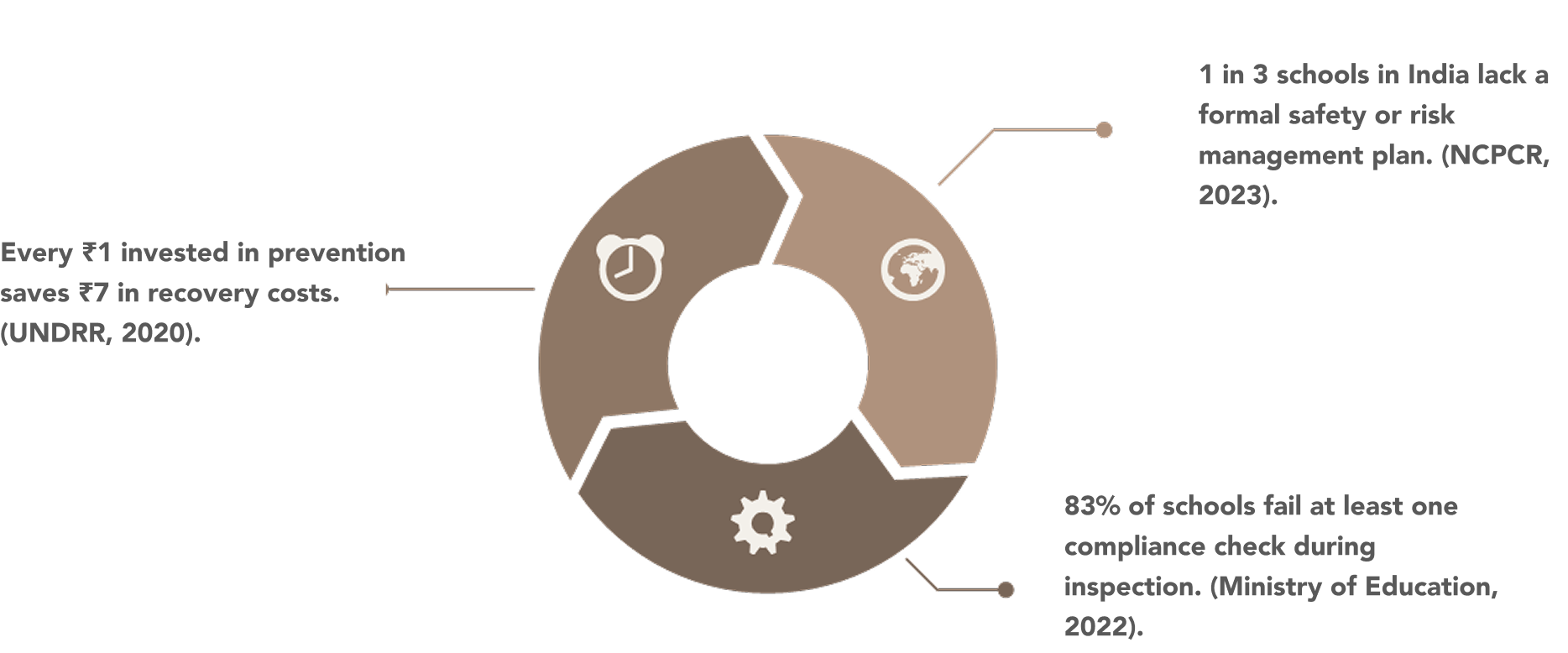
Schools face increasing challenges that demand proactive safety and risk management. A regular safety audit protects not just lives, but reputation and trust.
What Our Audit Covers?
Our safety audits go beyond surface-level checks. We evaluate every layer of your school’s ecosystem to ensure compliance, readiness, and resilience.
Campus Infrastructure & Physical Safety
We assess building design, exits, lighting, surveillance systems, and hazard zones to identify vulnerabilities.
Fire Safety & Emergency Preparedness
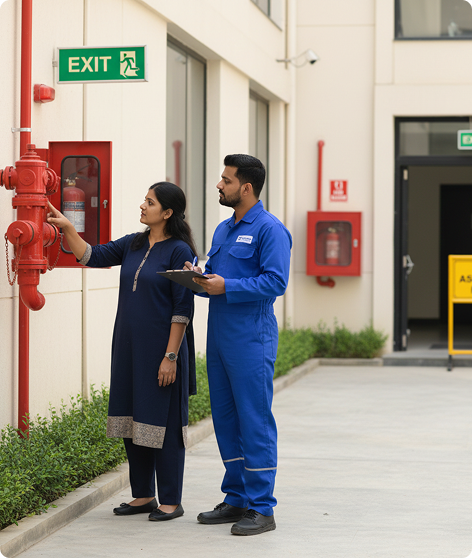
Inspection of alarms, extinguishers, evacuation routes, and emergency drill protocols.
Visitor Management & Access Control
Review of entry/exit systems, ID verification, and gate security processes.
Transport & Traffic Management
Evaluation of school bus routes, driver training, parking zones, and student pick-up safety.
Documentation & Policy Compliance
Verification of policies under NEP, POCSO, and Disaster Management Guidelines.
Staff Readiness & Safeguarding Practices
Observation of staff readiness, supervision quality, and child protection awareness.
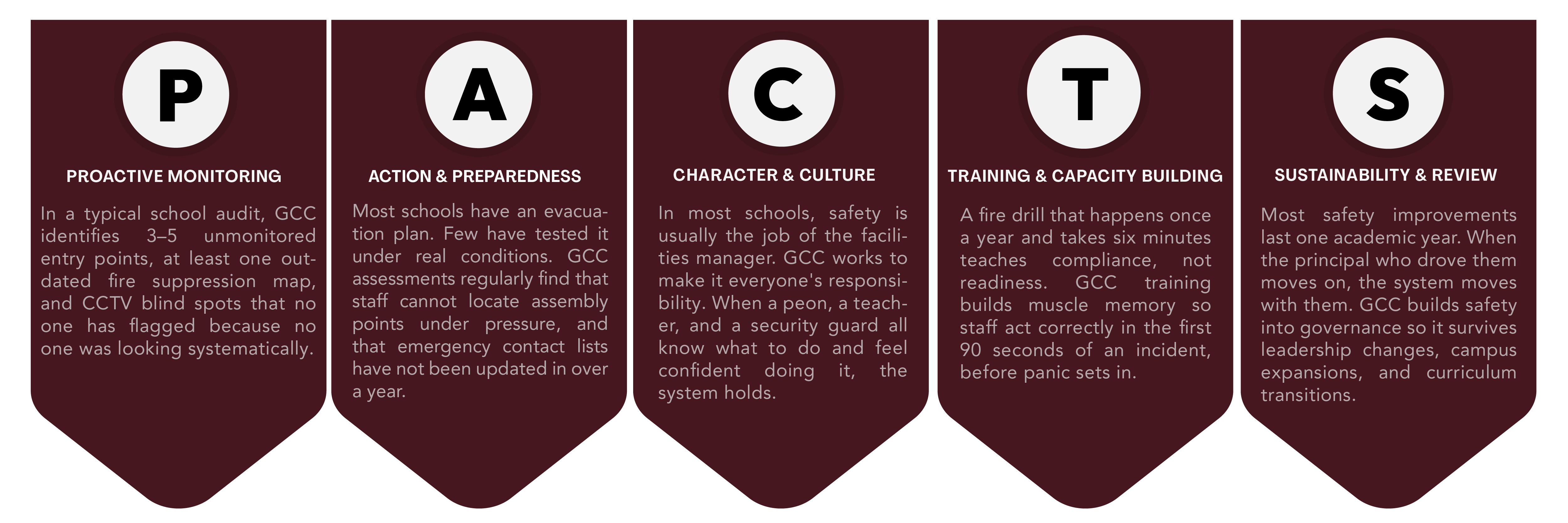
At Golden Circles Consultancy (GCC), our P.A.C.T.S Framework provides a structured, Five- part approach to help schools prevent risks, assess systems, correct gaps, train people, and sustain safety excellence.
I was genuinely impressed by their depth of knowledge and clarity of approach. They clearly outlined what each school needs to have in place, how comprehensive SOPs can be created, and the importance of regular follow-up and consistent maintenance of infrastructure.
Ms. Shuchi Shukla, Principal
Kanakia International School, Mumbai
My interaction with Golden Circles Consultancy on school safety was insightful and reassuring. Their team clearly understands today’s school challenges and offers practical, well-structured solutions. I especially valued their approach of integrating safety management into a single streamlined system, enabling clear protocols, easier follow-ups, and informed decision-making. They are a dependable partner for strengthening school safety practices.
Usman Karnalkar, General Manager
The Shri Ram Academy, Hyderabad
I sincerely appreciate Golden Circles Consultancy for strengthening school safety through trust-driven, context-specific solutions. Special thanks to Mr. Anuvret for strategic clarity and deep ecosystem understanding, translating needs into practical programs. The team’s professionalism shows safety as shared culture, not a checklist, creating meaningful impact for schools, educators, and children.
IS Ramakrishna AVP-Operations & Infra
The Shriram Hyderabad Schools Hyderabad
I sincerely appreciate Golden Circles Consultancy for strengthening school safety through trust-driven, context-specific solutions. Special thanks to Mr. Anuvret for strategic clarity and deep ecosystem understanding, translating needs into practical programs. The team’s professionalism shows safety as shared culture, not a checklist, creating meaningful impact for schools, educators, and children.
IS Ramakrishna AVP-Operations & Infra
The Shriram Hyderabad Schools Hyderabad
Get In Touch
We’re Here to Help You Build a Safer School Environment.
Get In Touch
We’re Here to Help You Build a Safer School Environment.
B-32, Flower Valley, Central Park 3, Sohna – Gurgaon Road, Gurgaon – 122103, India
Frequently Asked Questions
Get answers to common questions about our school safety services
1. Our school already follows CBSE / IB safety norms. What more does GCC add?
Compliance tells you what must exist on paper. GCC looks at how systems actually function on a regular school day under pressure, with real people, in real situations. We examine staff readiness, decision-making under stress, blind spots between policy and practice, and whether safety measures are understood rather than just documented.
2. Will GCC's work disrupt school routines or create fear among students and staff?
No. Our work is designed to fit into the rhythm of the school, not interrupt it. Safety is positioned as preparedness and confidence, not fear or surveillance. We are careful about language, tone, and timing especially with students and parents. When done well, schools report greater calm, not anxiety.
3. How is GCC different from a standard one-time safety audit?
Most safety audits end with a report. GCC focuses on what happens after the report, translating recommendations into clear actions, staff ownership, and sustainable practices. We work at the human level, not just the infrastructure level, because most safety failures happen because people hesitate, misjudge, or assume someone else will act.
4. When is the right time to engage GCC?
Schools typically engage GCC during moments of growth, transition, or reflection not only after an incident. Campus expansion, leadership changes, curriculum transitions, or the sense that policies exist but daily practice feels inconsistent are all the right moment. Engaging early means building systems before urgency dictates decisions.
5. Does GCC cover DPDPA compliance as well as physical safety?
Yes. GCC is one of the few school safety consultancies in India that covers both physical safety systems and digital data protection compliance under the DPDPA 2023. Schools collecting student data, which is every school, now have legal obligations around consent, breach notification, and data governance. We help schools meet those obligations before they become penalties.